
Le chat a sauté par-dessus la clôture.
The cat jumped over the fence.
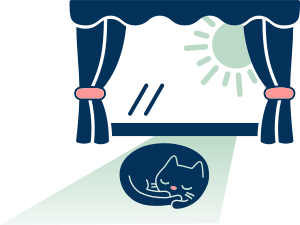
Le chat dormait au soleil.
The cat was sleeping in the sun.

The passé composé and the imparfait both describe the past, but they do so in different ways. This lesson will help you understand those differences and choose between them more confidently.
The compound past describes completed past events—it is built like a perfect tense (“have” + past participle) but is used as the everyday past.
The imperfect describes ongoing, habitual, or background actions in the past.
The passé composé treats an action as a completed event, often drawing attention to its beginning, end, or result. The imparfait describes actions and situations that were ongoing, repeated, or part of the background. This difference in perspective is called aspect. English shows a similar contrast between “I drove” and “I was driving.”
When choosing between them, think about whether you are presenting the action as a completed event or as part of an ongoing situation. The example and diagram below show how the two tenses can work together.
Je mangeais un croissant quand l'extraterrestre a atterri dans mon jardin.
I was eating a croissant when the alien landed in my garden.
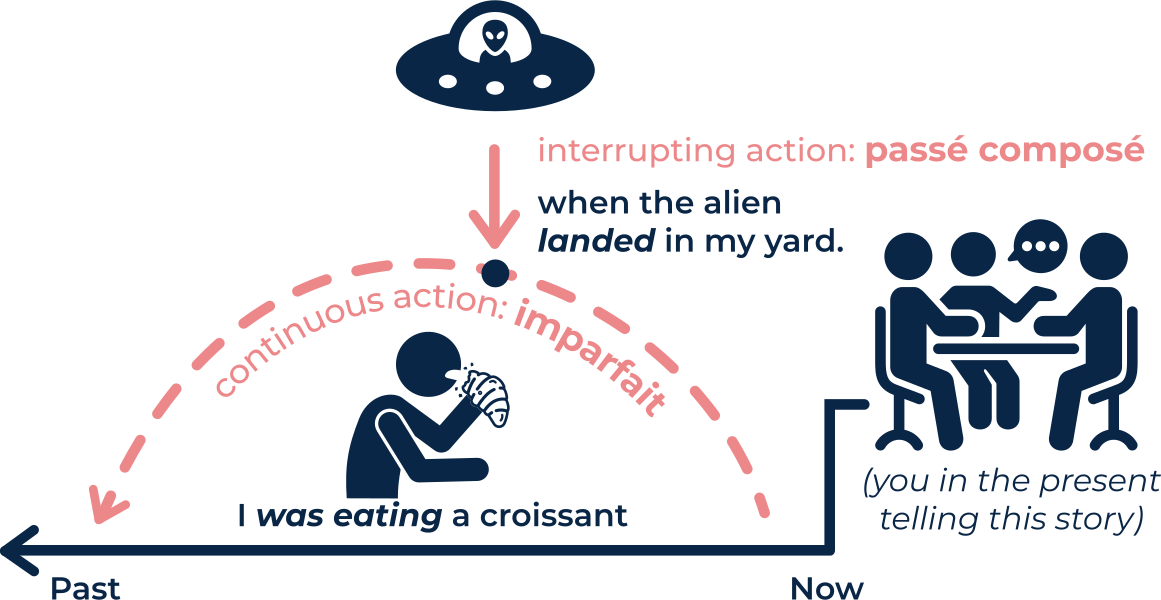
Here, mangeais is in the imparfait because "eating the croissant" was already in progress. a atterri is in the passé composé because the alien’s landing is a completed event that interrupts the ongoing action. Together, the two tenses create a clear narrative: the imparfait sets the scene for the event, while the passé composé moves the story forward.
Now let’s take a closer look. These five contrasts will deepen your understanding of how the two tenses differ in common situations.
(one time action/event)
(ongoing action/event)
Le chat a sauté par-dessus la clôture.
The cat jumped over the fence.
Le chat dormait au soleil.
The cat was sleeping in the sun.
The cat jumping over the fence is a singular, one-time event, making the passé composé the appropriate choice. The cat sleeping in the sun, by contrast, is an ongoing action, so the imperfect conveys its continuous aspect.
(one time action/event)
(ongoing action/event)

Hier soir, on a vu une étoile filante.
Last night we saw a shooting star.

On regardait les étoiles chaque nuit.
We used to look at the stars every night.
The sighting of the shooting star is a distinct event that occurred at a specific moment, so it uses the passé composé. On the right, the action is habitual or repeated without a specified frequency, making the imperfect the right choice for that ongoing, repeated nature.
(one time action/event)
(ongoing action/event)
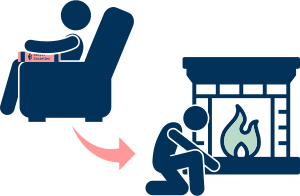
J'ai fermé mon bouquin, puis j'ai allumé le feu.
I closed my book, then lit the fire.

Je lisais mon bouquin pendant que le feu me réchauffait.
I read my book while the fire warmed me.
Closing the book and then lighting the fire are sequential, one-time events; the passé composé is appropriate. Reading and being warmed by the fire, however, happen simultaneously and are ongoing, so the imperfect is needed.
(one time action/event)
(ongoing action/event)

Elle a été contente quand elle a reçu les fleurs.
She was happy when she received the flowers.

Elle était contente à la fête.
She was happy at the party.
On the left, she experiences a change in her emotional state because of a specific event, which calls for the passé composé. On the right, her happiness is continuous, with no change in state, so the imperfect describes her ongoing emotion.
(one time action/event)
(ongoing action/event)

J'ai voyagé en Europe pendant un mois.
I traveled around Europe for a month.

Je voyageais en Europe.
I used to travel around Europe.
On the left, the traveling has a defined duration of one month, establishing a clear endpoint—that specificity calls for the passé composé. On the right, traveling through Europe lacks a definitive timeline or conclusion, making the imperfect more suitable for its indefinite, ongoing nature.
Master these verb conjugations from Lesson 18